søndag 30. mai 2010

3rd CONFRONTATION

Third confrontation is over and after these two days workshop/talkshop I am not shure how I will finish my project, or what a project this is...

Tomorrow, (or at least very soon) I will have to make some decisions on which directions I want to go, and start to focus on what to finish for the final exam.

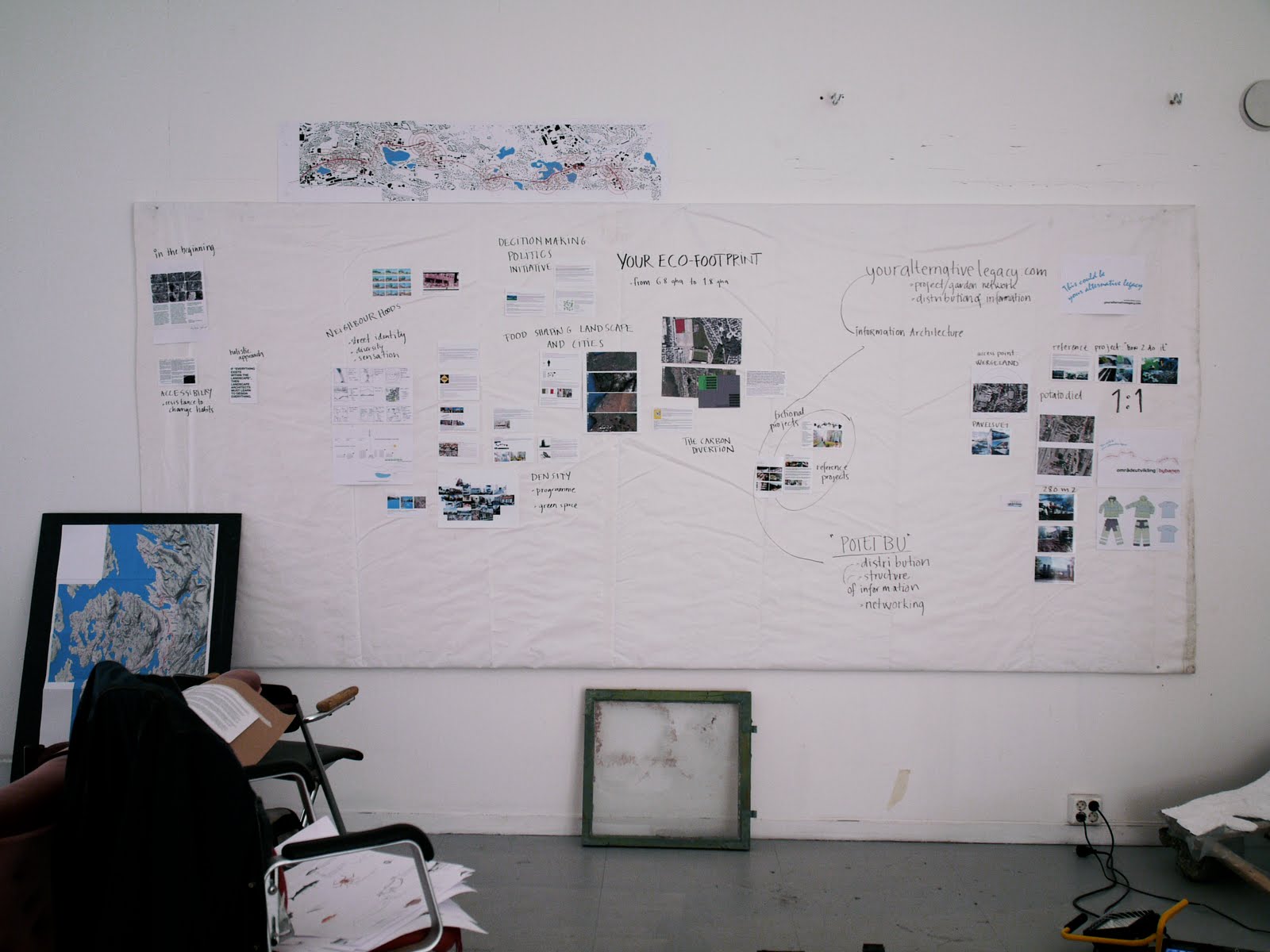
(My) Wall of explored themes and where it could end? Master plan or information architecture?

tutor André Fontes talks of systems and logic...

co-student Marens project on Skudeneshavn

co-student Johs´project from Paradis, Bergen. Also working with development of one of the stops along the light rail.

workshop studio...

fredag 28. mai 2010

GROWING THINGS PART 2


Mangold; 4 days, 23 days


pumkin; 4 days, 6 days, 23 days


salad; 3 days, 23 days

beetroot


green squash


coriander; 5 days, 8 days


green beans; 5 days, 8 days, 14 days, 20 days


ruccula; 4 days, 10 days

peas; 12 days, 19 days, 23 days

tirsdag 25. mai 2010

URBAN GARDENING ON THE LIST OF ACTION

As part of the 1:1 sketching (that can be a helpful tool in investigating sizes, shapes, flow, continuity or trying to find out something you are not shure of yet), I wanted to visualize the size of the ideal eco-footprint vs the eco-footprint of the average Norwegian... (test your eco-footprint). But the sizes became a little large to manage, so the second best choice is to look at the diet part of the footprint issue. Based on the potato diet me and my wonderful helpers Ragnhild and Stine B went out Friday morning with the intention to do some serious urban agriculture action at Wergeland/Minde!
Here follows the recipe (if you would ever want to do it your self sometime);

In advance it is Ok to find a suitable setting for a potato garden. A roadside can work just perfectly. (clic on the images to enlarge)


This is needed to cover 284m2 which is the amount needed to produce enough calories for one very active person, for one year;
:: 10 bags (5kg) of potatoes is needed
:: an amount of chicken/cow shit, or any other (organic) nutrient.
:: time

tools: spade, gloves, uniform, energy and good spirit (to manage all the comments and questions that will arise while setting the potatoes), and signs to put up along your potato field to prevent the city gardeners cut down the potato plants like grass...


Leave the potatoes out in daylight for a few weeks prior to setting them out in the soil, so they can start the growing process.


On your chosen site; dig long canals to put the potatoes in (or just holes), 30 cm between each potato, 3 cm deep, remember putting some nutrient in the hole and cover them with approx 8 cm soil.

And now we wait for the potatoes to start growing. Exiting!


During the growing period it is good to return to the site and cover the roots of the plants (with anything organic), this is to prevent the potatoes growing close to the surface to turn green. Green potatoes is toxic, especially for young children. Hutting (covering) the "root" of the potato plant also gives better veggies.

Waiting, waiting, waiting....

fredag 14. mai 2010

ORGANIZATION OF INFORMATION AND FASCINATION OVER GROWING THINGS

Its spring, almost summer, and its time for planting. All kinds of vegetables. Its growing like crazy in my kitchen window and out in the garden. And soon in a road side at Wergeland!

But also the chaos of information is growing so I am working on ways to structure and linking it, so it will (hopefully) make sense in the end (6th of august is the deadline).

This is the words from my tutor (Vibeke);
"Information architecture (IA) is the art of expressing a model or concept of information used in activities that require explicit details of complex systems. a structural design of shared environments, methods of organizing and labeling websites, intranets, and online communities, and ways of bringing the principles of design and architecture to the digital landscape. jeg tenkte meg en slags reversering av denne prosessen: ways of bringing the principles of the structural design of shared environments, methods of organizing and labeling websites, intranets, and online communities to develop physical/architectural nodes (kiosks) that display, gather, generate info and social encounters around local sustainable living informasjonen du sitter på og har samlet på bloggen din er ikke tomt materiale! det du kan gjøre er å komme opp med en måte å skape en fysisk struktur som synliggjør materialet og formidler møter og aktiviteter lokalt 1:1 skisse er en veldig god måte å få lokal interesse for prosjektet ditt, ikke bare prat/info men real action that's power! (folk sier ofte om konseptuell kunst: 'i could have done that' - hvorpå svaret følger: yes, but you didn't - that's the difference! so go out and DO IT!
beste hilsen v"

Trying to get an overview of information while I get my hands dirty...
Tell you all about it soon, in the meantime you can enjoy the growing process!

torsdag 29. april 2010

IDENTITY, SENSATION AND DIVERSITY IN THE STREETS


Investigating concepts, shapes, programs and attributes of the streetscape....
What makes one block or street more interesting than others?
With inspiration from f.ex the BORNEO project in Amsterdam (WEST8), and other street views and experiences, I am searching for some qualities, attributes, intrinsic values etc that gives character to a neighborhood.
This is qualities that one can sense when first experiencing a street or neighborhood, the visual impulses and aesthetics. But living in and being a user of a place connects experiences of other dimensions to the feeling of a place and the care (or lack of care) you feel for it, in the perspective of investing time and energy to it, making it your own.

The mosaic above is different images from Paris and Malmø I took when visiting the cities last autumn. Both the cities have a lot of characteristics and varieties that I liked. Especially Paris has a rich variety in programs on street level that the neighbors use; bakery, coffeshop/cafés, grocery stores, laundry etc. Makes it possible for people to do their necessary things within their area... Which again make the area active...


The two pictures above shows the facades from both sides of Nygårdsgaten here in the City of Bergen, a varied street with different programs on street level and mostly apartments from first floor and above. How can one regulate an area or lead development into a varied expression like this? Is this possible? Maybe the Borneo development shows that it can? I have not seen it myself but the images seems promising...